
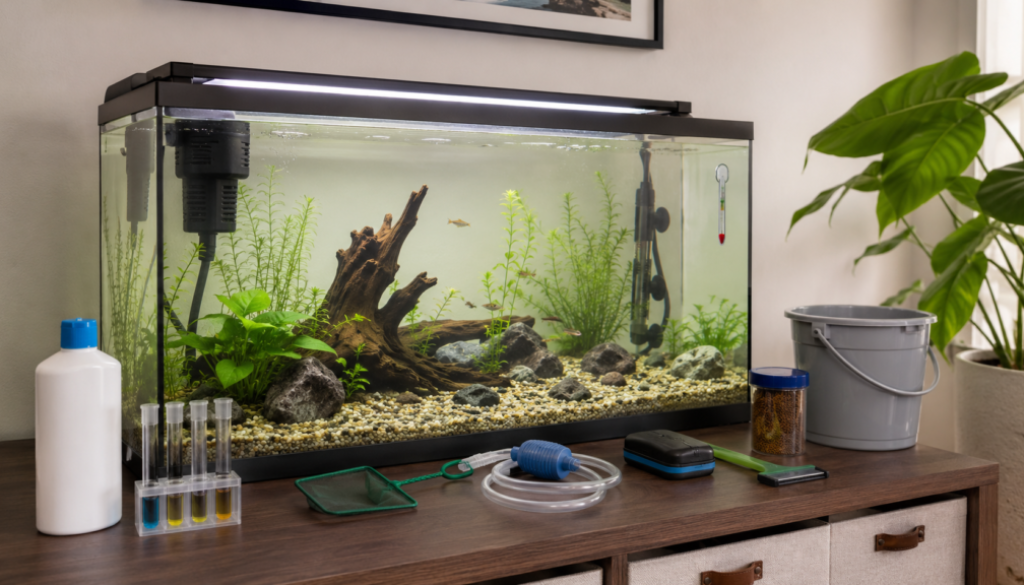
Starting your first aquarium is exciting, but choosing the right equipment can quickly become confusing. Filters, heaters, lights, test kits, air pumps, water conditioners and cleaning tools all seem important, but not every product on the shelf is truly necessary for every beginner.
The good news is that a healthy freshwater aquarium does not need to be complicated. What it does need is the right foundation. Essential aquarium equipment helps keep the water clean, stable and safe for fish, plants and beneficial bacteria.
A beginner aquarium should not be built around decoration first. It should be built around water quality, filtration, temperature, lighting and regular maintenance. Once those basics are in place, the aquarium becomes much easier to manage.
Effective filtration and good water quality are key parts of a healthy aquarium, and biological filtration is especially important because it helps break down fish waste inside the tank.
Key Points (TLDR)
Why Aquarium Equipment Matters
An aquarium is a closed environment. In nature, water is constantly moving, refreshing and balancing itself. In a home aquarium, that balance depends on the equipment you choose and the care routine you follow.
The right aquarium equipment helps with:
- filtering waste from the water
- supporting beneficial bacteria
- keeping the temperature stable
- providing proper light for fish and plants
- making water changes easier
- preventing stress caused by poor water conditions
- helping beginners notice problems early
Many beginner problems happen because the tank is not properly equipped from the start. A weak filter, unstable temperature or lack of water testing can cause issues even when the aquarium looks clean.
Clear water does not always mean safe water. Fish waste and uneaten food can affect water quality before visible problems appear. That is why equipment such as filters and test kits is not just optional decoration; it is part of basic fish care.
1. Aquarium Tank
The first piece of essential aquarium equipment is, of course, the tank itself. But beginners often underestimate how important tank size is.
A very small aquarium may look easier, but it can actually be harder to maintain. In small tanks, temperature and water quality can change quickly. A larger tank usually gives beginners more stability and more room for error.
When choosing your first aquarium, consider:
- how much space you have at home
- what fish species you want to keep
- how many fish the tank can safely support
- whether the furniture can carry the tank’s weight
- how easy it will be to clean and maintain
A starter aquarium kit can be a practical option for beginners because many kits include several basic items such as a tank, cover, light, filter, heater, thermometer, food, water conditioner and setup guide.
However, not every kit is perfect. Some budget kits include equipment that may need upgrading later, especially if the filter or light is too basic for the type of aquarium you want to build.
2. Aquarium Filter
The filter is one of the most important pieces of equipment in a freshwater aquarium. Many beginners think a filter simply removes visible dirt from the water, but its role is much bigger than that.
A good aquarium filter supports three main types of filtration:
Mechanical filtration
This removes physical particles, such as debris, uneaten food and plant matter.
Biological filtration
This supports beneficial bacteria that help process fish waste.
Chemical filtration
This can help remove certain dissolved substances, depending on the filter media used.
RSPCA explains that aquariums use mechanical, chemical and biological filtration, with biological filtration being the most important because it helps break down fish waste.
For beginners, a filter should be suitable for the size of the tank and the type of fish being kept. A filter that is too weak may not keep up with waste, while a filter with very strong flow may stress slow-moving fish.
Common beginner filter options include:
- hang-on-back filters
- internal filters
- sponge filters
- canister filters for larger aquariums
For a first freshwater tank, hang-on-back filters, internal filters and sponge filters are often the easiest options to understand and maintain.
3. Aquarium Heater
Many popular beginner fish are tropical freshwater fish, which means they need warm and stable water. In that case, an aquarium heater is essential.
A heater helps keep the water temperature steady, especially during the night or in colder rooms. Sudden temperature changes can stress fish and make them more vulnerable to illness.
A suitable heater should match the size of the aquarium. It should also be placed where water circulates well, so heat spreads evenly through the tank.
A heater is especially important for fish such as:
- guppies
- platies
- bettas
- tetras
- rasboras
- many tropical community fish
If you keep temperate or tropical fish, a heater may be required, while marine aquariums usually need more specialized equipment.
4. Thermometer
A heater is not enough on its own. You also need a thermometer to check whether the water temperature is actually correct.
Thermometers are simple, affordable and very useful. They help you notice problems such as heater failure, overheating or sudden temperature drops.
Common aquarium thermometer types include:
- stick-on thermometers
- glass thermometers
- digital thermometers
Digital thermometers are easy to read, but any reliable thermometer is better than guessing. The important thing is to check it regularly.
Temperature stability is one of the most important parts of aquarium care. RSPCA also notes that new water added during refilling should not be a different temperature from the aquarium water, because this can shock the fish.
5. Aquarium Lighting
Aquarium lighting has two main purposes. It helps you see the tank clearly, and it supports live plant growth if you keep aquarium plants.
For a beginner freshwater aquarium, LED lighting is usually the most practical choice. LED lights are energy-efficient, long-lasting and widely available in aquarium kits.
However, more light is not always better. Too much light can encourage algae growth, especially if the tank receives direct sunlight or if the light stays on for too many hours each day.
A good beginner lighting routine is usually around 6–8 hours per day, especially in planted tanks. A timer can help keep the schedule consistent.
Lighting is especially important if your aquarium includes:
- live plants
- aquascaping features
- fish with natural day/night behavior
- a tank placed in a darker room
Avoid placing the aquarium near a window, because direct sunlight can increase algae growth and temperature instability. Aqueon also advises avoiding locations near windows or drafty doorways when choosing where to place an aquarium.
6. Aquarium Substrate
Substrate is the material placed at the bottom of the aquarium. It can be gravel, sand, planted aquarium soil or another aquarium-safe material.
Substrate is not only decorative. It also affects how the aquarium looks, how easy it is to clean and whether certain fish or plants will do well.
Common substrate options include:
Gravel
Easy to use and common in beginner tanks. Waste can collect between the stones, so regular vacuuming is important.
Sand
Good for bottom-dwelling fish such as corydoras because it is softer on their barbels. It should be cleaned gently to avoid compacting or disturbing it too much.
Plant substrate
Useful for planted aquariums, especially if you want root-feeding plants.
When choosing substrate, think about the fish first. Sharp gravel can be uncomfortable or even harmful for bottom-dwelling species. Smooth gravel or fine sand is usually a safer choice for many beginner community tanks.
7. Water Conditioner
Water conditioner is one of the most important beginner aquarium supplies. Tap water may contain chlorine or chloramine, which can be harmful to fish and beneficial bacteria.
A water conditioner helps make tap water safer before it enters the aquarium. This is especially important during water changes and when first filling the tank.
RSPCA states that chlorine in tap water is dangerous to both fish and bacteria, so a dechlorinating product should be added to new water, or the water should be left standing for chlorine to leave.
For beginners, using a reliable water conditioner is usually the simplest and safest approach. It is easy to use and should be part of every water change routine.
Water conditioner is used when:
- setting up a new aquarium
- doing weekly water changes
- topping up evaporated water
- preparing emergency water changes
This small bottle can prevent major problems, so it should always be available near your aquarium supplies.
8. Aquarium Water Test Kit
A water test kit is often overlooked by beginners, but it is one of the most useful tools you can own.
Fish can be stressed by poor water quality long before the aquarium looks dirty. A test kit helps you understand what is happening in the water instead of guessing.
The most important parameters for beginners are:
- ammonia
- nitrite
- nitrate
- pH
- temperature
In a healthy, cycled aquarium, ammonia and nitrite should usually remain at zero. Nitrate should be controlled through regular water changes, good filtration and responsible feeding.
Test strips are quick and easy, but liquid test kits are often more accurate. For a beginner freshwater tank, either option is better than not testing at all.
Water testing is especially important:
- during the first weeks of a new aquarium
- after adding new fish
- if fish behave strangely
- after a filter problem
- when the water becomes cloudy
- if algae suddenly increases
A test kit helps turn aquarium care from guesswork into informed maintenance.
9. Fish Net
A fish net is a simple but essential aquarium tool. It is useful for moving fish, removing floating debris or catching loose plant leaves.
Choose a net that is suitable for the size of your fish. A very large net can be clumsy in a small tank, while a very small net can make fish harder to catch and increase stress.
A soft, fine-mesh net is generally safer for delicate fish and long fins.
Use a fish net gently. Chasing fish around the tank can stress them, so it is better to move slowly and calmly.
10. Gravel Vacuum or Siphon
A gravel vacuum, also called a siphon, is essential for regular aquarium maintenance. It helps remove dirty water while cleaning waste from the substrate.
During weekly maintenance, a siphon can remove:
- fish waste
- uneaten food
- decaying plant matter
- debris trapped in gravel
- water for partial water changes
A gravel vacuum is especially useful in tanks with gravel substrate, where waste can fall between the stones. In sand tanks, the siphon should usually be held slightly above the surface to remove debris without removing too much sand.
This tool makes water changes easier, cleaner and more effective.
11. Algae Scraper or Magnetic Cleaner
Some algae growth is normal in aquariums. However, when algae covers the front glass, it can make the tank look dirty and reduce visibility.
An algae scraper or magnetic glass cleaner helps remove algae from the aquarium glass.
Common options include:
- sponge algae pads
- magnetic cleaners
- scraper tools
- soft brushes for decorations
Never use household cleaning products, soap or kitchen sponges that may contain chemicals. Only use tools that are safe for aquariums.
For acrylic tanks, use tools specifically made for acrylic, because some scrapers can scratch the surface.
12. Aquarium Lid or Cover
An aquarium lid is useful for several reasons. It helps reduce evaporation, prevents fish from jumping out and keeps dust or household objects from falling into the water.
Some fish are more likely to jump than others, especially when startled. A cover gives extra protection and makes the aquarium safer.
Many aquarium kits include a cover and light system together. Starter kits often include items like a tank, cover and light, filter, heater, thermometer and other beginner supplies.
A lid is especially useful if you have:
- bettas
- danios
- rasboras
- small active fish
- pets or children at home
- an open-top aquarium in a busy room
Open-top aquariums can look beautiful, but beginners often find covered tanks easier and safer.
13. Aquarium Stand or Stable Surface
An aquarium becomes very heavy once it is filled with water, substrate, rocks and decorations. A weak table or unstable shelf can be dangerous.
A proper aquarium stand or strong, level surface is important, especially for larger tanks.
Before placing an aquarium, make sure the surface is:
- level
- strong enough for the filled tank
- stable
- away from direct sunlight
- away from drafts and heaters
- close enough to an electrical outlet
Aqueon advises that larger tanks, generally over 10 gallons, should have an appropriate stand to support the aquarium’s weight.
This is not the most exciting part of aquarium setup, but it is one of the most important for safety.
14. Aquarium-Safe Decorations
Decorations make the aquarium look natural and give fish places to explore, hide and feel secure.
Aquarium-safe decorations may include:
- rocks
- driftwood
- caves
- ceramic ornaments
- artificial plants
- live plants
Avoid decorations that are sharp, painted with unsafe materials or not made for aquarium use. Some rocks can also affect water chemistry, so it is safer for beginners to buy aquarium-safe materials from reliable sources.
Fish feel safer when they have hiding places. A completely empty tank can make some fish more nervous, especially small community fish.
15. Fish Food
Fish food is basic equipment in the practical sense because it directly affects fish health and water quality.
Beginners often overfeed fish, which can cause leftover food to decay in the aquarium. This can lead to poor water quality and algae problems.
Choose food suitable for your fish species. Common options include:
- flakes
- micro pellets
- sinking pellets
- algae wafers
- frozen or freeze-dried foods
- species-specific diets
Community fish often do well with quality flakes or small pellets, while bottom-dwelling fish such as corydoras need sinking foods.
A good rule is to feed small amounts and observe whether the fish eat everything quickly. If food regularly falls to the bottom and remains uneaten, reduce the amount.
Optional Aquarium Equipment Beginners May Need
Not every tank needs every device. Some aquarium equipment is useful only in specific situations.
Air Pump
An air pump can increase water movement and oxygen exchange. It is useful with sponge filters, air stones or tanks that need extra surface agitation.
However, if your filter already creates good surface movement, an air pump may not be necessary.
Timer
A light timer is simple but very useful. It keeps the lighting schedule consistent and helps prevent algae caused by excessive light.
Plant Fertilizer
If you keep live plants, you may need liquid fertilizer or root tabs depending on the plant species and substrate.
Aquarium Background
A background is not essential, but it can improve the appearance of the tank and help fish feel more secure.
Quarantine Tank
A quarantine tank is very useful for experienced hobbyists and can help prevent disease from spreading to the main aquarium. Beginners may not start with one immediately, but it is worth considering as the hobby grows.
Equipment Beginners Usually Do Not Need Immediately
Some products are useful in advanced setups but not essential for a first freshwater aquarium.
Beginners usually do not need:
- CO₂ systems for simple low-light plants
- UV sterilizers in a healthy basic tank
- protein skimmers for freshwater aquariums
- automatic feeders unless they travel often
- complex dosing systems
- expensive aquascaping tools at the beginning
The best first aquarium is simple, stable and easy to maintain. Adding too much equipment too soon can make the hobby feel more complicated than it needs to be.
Beginner Aquarium Equipment Checklist
Here is a simple checklist of essential aquarium equipment every beginner should consider:
- Aquarium tank
- Stable aquarium stand or strong surface
- Aquarium filter
- Heater, if keeping tropical fish
- Thermometer
- Aquarium light
- Aquarium lid or cover
- Substrate
- Water conditioner
- Water test kit
- Fish net
- Gravel vacuum or siphon
- Algae scraper or magnetic cleaner
- Aquarium-safe decorations
- Suitable fish food
This list covers the basic tools needed for a healthy beginner freshwater aquarium.
Common Beginner Mistakes When Buying Aquarium Equipment
Buying aquarium equipment is easier when you know what to avoid.
Buying a tank that is too small
Very small tanks can be unstable and harder to maintain.
Choosing a weak filter
A filter should match the tank size and fish load.
Forgetting the heater
Many beginner fish are tropical and need stable warm water.
Skipping the test kit
Without testing, it is hard to know whether the water is safe.
Using untreated tap water
Chlorine and chloramine can harm fish and beneficial bacteria.
Buying too many decorations before the basics
Filtration, temperature and water quality matter more than appearance.
Overcomplicating the setup
A simple, well-equipped aquarium is better than a complicated tank that is hard to maintain.
Final Thoughts
The essential aquarium equipment every beginner needs is not about buying the most expensive products. It is about choosing the right basics: a suitable tank, reliable filter, stable heater, thermometer, lighting, water conditioner, test kit and simple cleaning tools.
A healthy aquarium starts with stable water. Equipment should support that stability and make regular maintenance easier.
Once the foundation is correct, the aquarium becomes more enjoyable, less stressful and safer for fish. With the right beginner aquarium equipment, your first freshwater tank can become a clean, balanced and beautiful environment from the start.
FAQ
What equipment do I need for a beginner aquarium?
A beginner aquarium usually needs a tank, filter, heater if keeping tropical fish, thermometer, light, substrate, water conditioner, test kit, fish net, gravel vacuum and algae scraper.
Do I need a heater for a freshwater aquarium?
You need a heater if you keep tropical freshwater fish. Some temperate fish may not need one, but the water temperature should still remain stable.
Is an aquarium filter necessary?
Yes, a filter is one of the most important pieces of aquarium equipment. It helps remove debris, supports beneficial bacteria and maintains water quality.
Do beginners need a water test kit?
Yes. A water test kit helps check ammonia, nitrite, nitrate and pH. These parameters are important because poor water quality may not be visible immediately.
Do I need an air pump in my aquarium?
Not always. If your filter creates enough surface movement, an air pump may not be necessary. It is useful for sponge filters, air stones and tanks that need extra oxygen exchange.
What should I buy first for a fish tank?
Start with the tank, stand, filter, heater, thermometer, light, substrate, water conditioner and test kit. Fish should be added only after the aquarium is properly set up and cycled.